28
10
2026
By Eve Painter
How long does it take to hire a firmware engineer?
Back to BlogsQuick answer: Hiring a firmware engineer in the UK typically takes six to twelve weeks from brief to accepted offer. Add the candidate’s notice period, usually one to three months, and most firmware engineers start two to six months after you first decide to hire. Roles that need security clearance can take longer still, unless you hire someone who already holds it.
Why does it take so long?
Firmware engineers are scarce, and most good ones are employed, busy or not looking. That means a recruiter has to find them and persuade them, rather than wait for applications. Firmware roles are also tied to specific hardware, so you can’t widen the net to anyone who writes code. Someone with years of bare-metal C on microcontrollers is a different hire to an embedded Linux engineer, and both are different again from someone working on safety-critical systems.
A senior firmware engineer often has a three-month notice period, so even a fast hire can take a while to start.
What are the stages, and how long does each take?
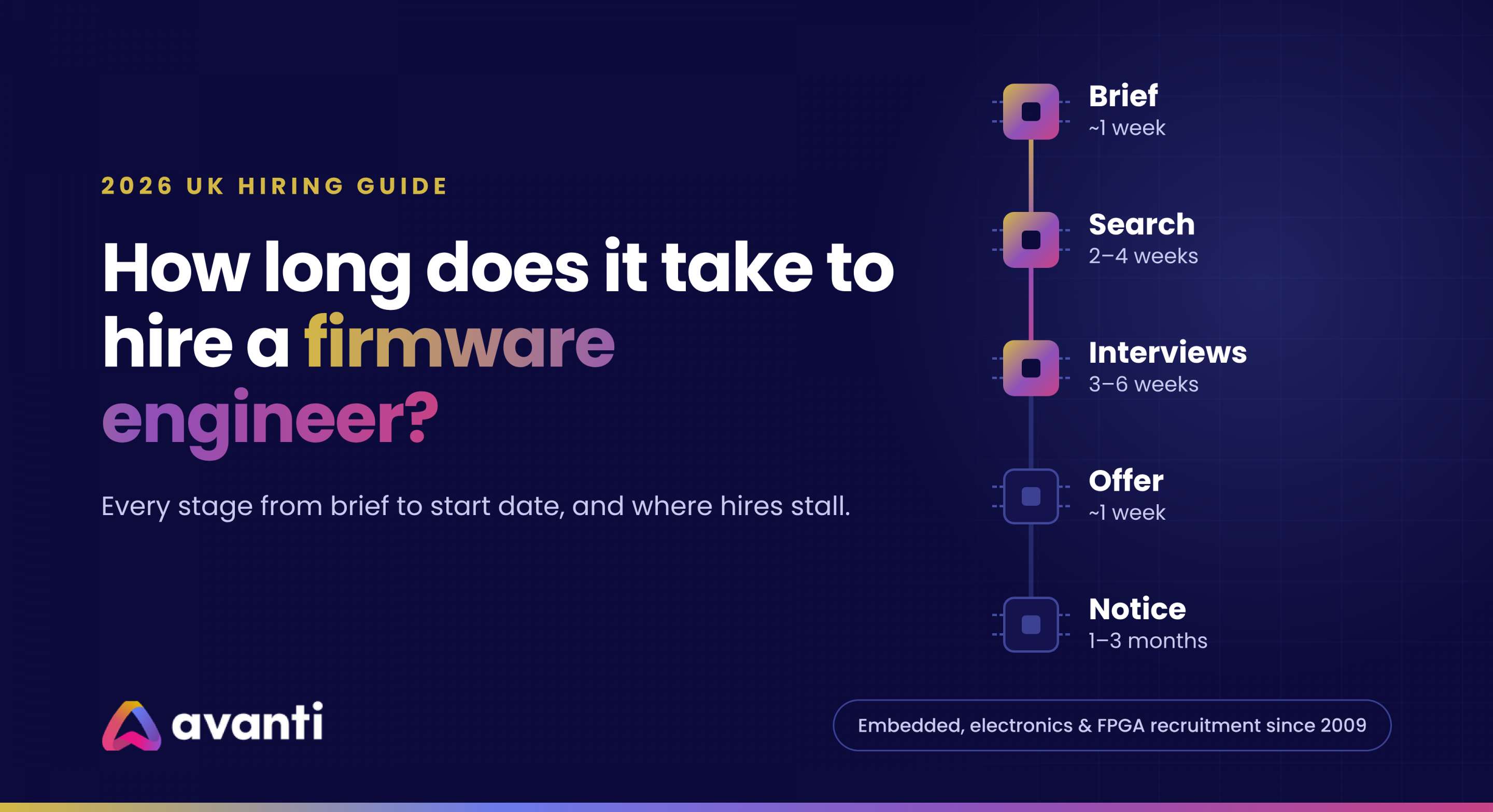
Brief and sign-off: about a week
Agree the role, the must-have skills and the salary before anything goes out. This stage is often slower than people expect, because budget sign-off and job spec changes happen internally. Going to market before it’s settled is the most common cause of a search restarting halfway through.
Finding candidates: two to four weeks
A specialist recruiter with an embedded network can usually get a first shortlist to you within two to four weeks. Relying on a job advert alone takes longer, because the strongest candidates aren’t reading job boards.
Interviews: three to six weeks
Most firmware hires run two stages: a technical interview, often with a practical task or a hardware discussion, and a final meeting with the team or a senior leader. Each extra round adds about a week, and every week adds risk that a candidate accepts something else.
Offer: about a week
A clean offer and acceptance can take a few days. Counter-offers are common for firmware engineers, because their current employer knows how hard they are to replace, and that can add another week.
Notice period: one to three months
Junior engineers often work one month’s notice. Senior and lead engineers often work three. Some employers will agree an earlier release, but plan for the full period.
How does security clearance change the timeline?
For defence and government work, clearance can be the longest stage. In 2026, a new SC clearance commonly takes two to three months, and DV clearance takes six to nine months. Some of that can run during the candidate’s notice period, but not always all of it.
The fastest route is to hire someone who already holds an active clearance, which can usually be transferred to a new employer in weeks. That’s why cleared firmware engineers are in such high demand, and why they cost more.
What slows firmware hires down?
- Starting the search before the salary and spec are agreed
- Salary bands set below the market, so candidates drop out at offer stage
- Three or more interview rounds
- Feedback that takes more than a couple of days, which tells candidates they’re not a priority
- Asking for a perfect match on every tool and chip, rather than the skills that actually matter for the role
How can you speed it up?
Fix the salary before you start, using current market data rather than last year’s figures. Our guide to how to hire embedded engineers in the UK covers 2026 salary bands.
Keep to two interview stages, book them in advance, and give feedback within 48 hours. Decide what’s essential and what can be learned. A strong engineer who has worked on a different microcontroller family will get up to speed far faster than a search that drags on for another month.
If you need someone working sooner than three months away, bring in a contractor to cover the gap while the permanent search runs.
Hiring firmware engineers with Avanti
Avanti has recruited embedded, firmware and electronics engineers across the UK since 2009, and works with a network of engineers who aren’t actively job hunting. For one or two important hires, a Recruitment Partnership works on a success-fee basis. For an urgent gap, Contract Recruitment gets a firmware specialist in quickly, with you keeping control of the work.
The short version
- Expect six to twelve weeks from brief to accepted offer, and two to six months until your new engineer starts.
- Notice periods of one to three months are usually the biggest single delay, so plan for the full period.
- A new SC clearance commonly adds two to three months, so hiring someone already cleared is usually faster.
- Agree salary first, keep to two interview stages and give feedback within 48 hours.
If you’re hiring firmware engineers this year and want a view on timelines or availability, contact Kirstin Jarvis on 0118 402 4650 or K.J@avantirec.com.

26
10
2026
How to hire great people below market rate
Not every company can pay top of market, and the salaries up there keep climbing. That doesn't mean you can't hire great people. It means you have to win them on something other than money. These are the tactics we'd use Offer fully remote F
23
10
2026
How to be better at interviewing than 99% of companies
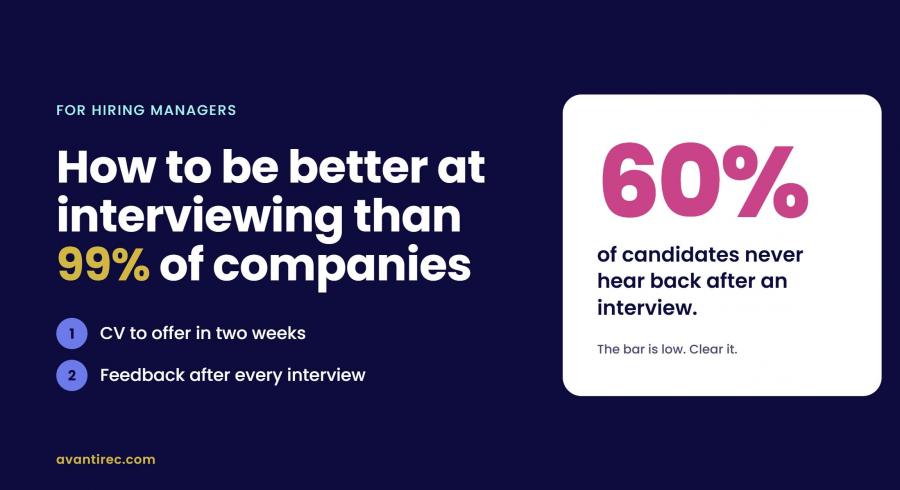
The bar for how companies treat people in interviews is low. Around 60% of candidates never hear back after an interview at all. Surveys reckon people now find that silence more frustrating than being ghosted after a first date. That's oddly good
21
10
2026
How AI has changed recruitment
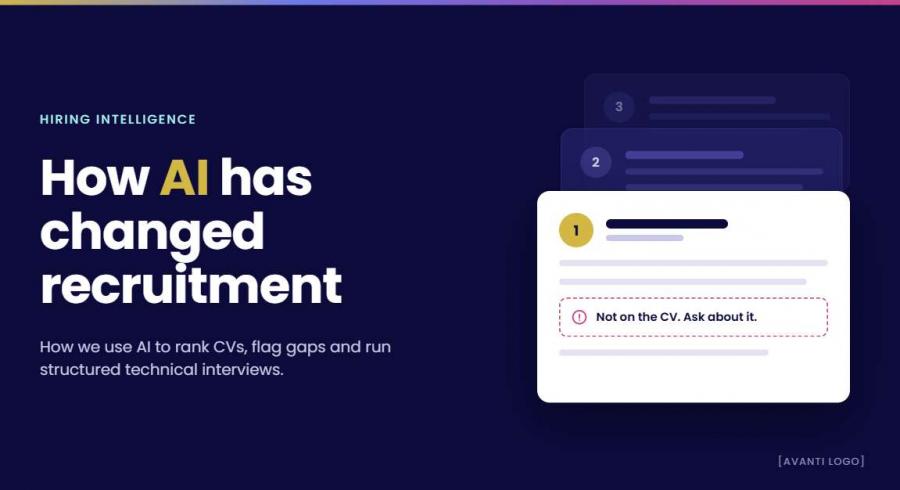
AI has changed how everyone works, and recruitment is no exception. Here's how we're seeing it change things day to day. None of it is robots deciding who gets hired. The judgement still sits with people. AI just does the legwork and gets us there